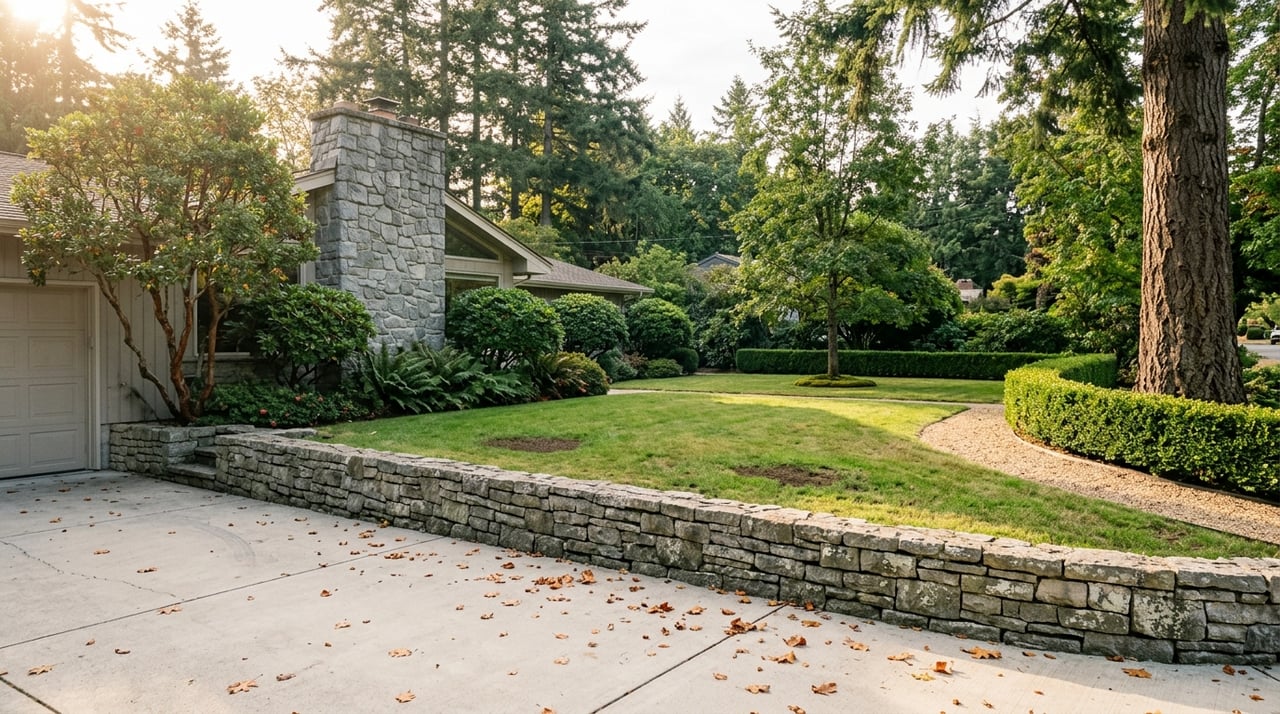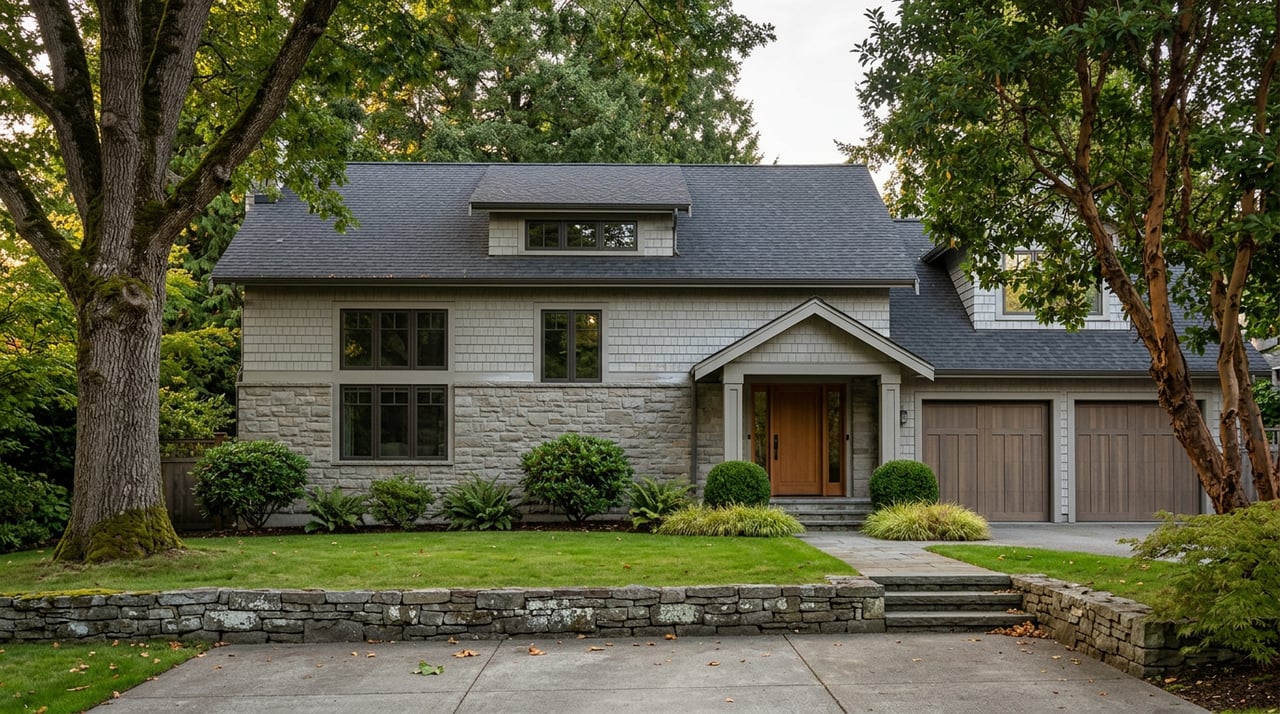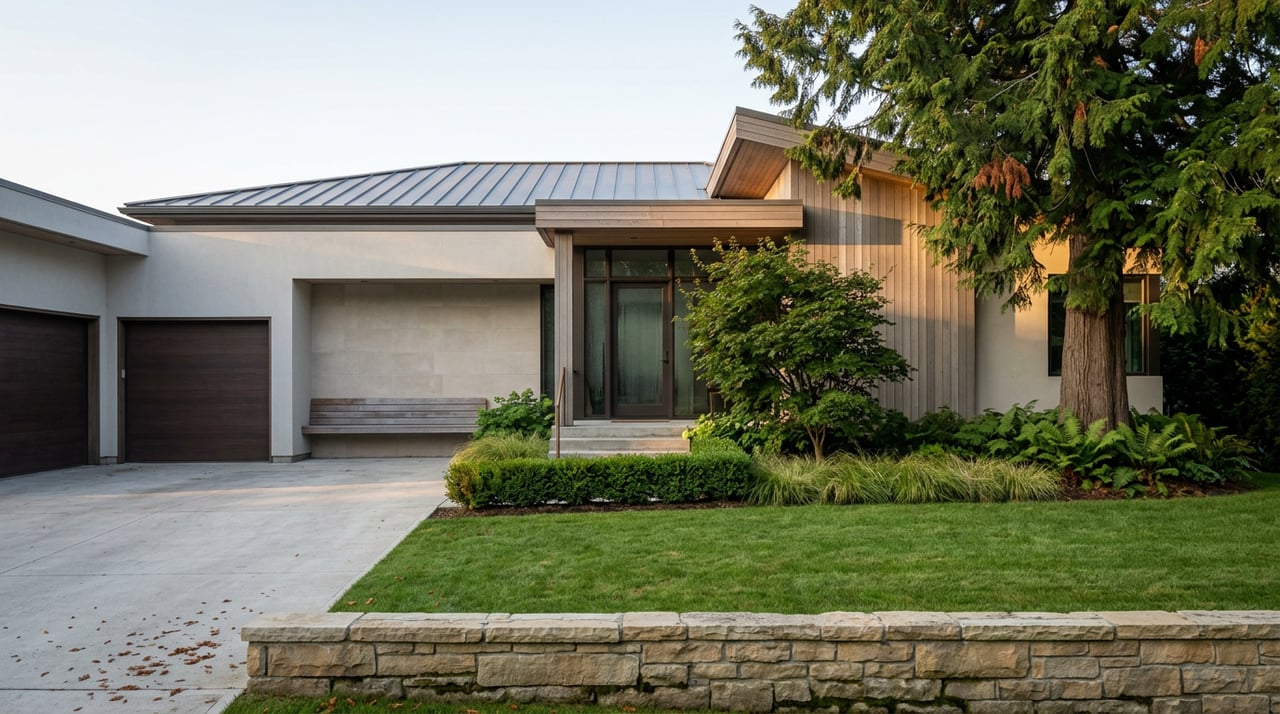
Two houses sit a block apart in Gordon Head, on streets that could be interchangeable. Same era of bungalow, same depth of lot, same low hedge along the front property line. Nothing in the BC Assessment record, the survey, or the way the street looks from a car window tells you that one of these lots can become a six-unit houseplex without a single rezoning application, while the other tops out at three or four units under the exact same provincial rules.
The difference lives in a transit designation attached to a specific bus stop, and Saanich's own planning department will tell you, if you ask directly, that the map determining which stops qualify is not finished being drawn.
The Number Most People Stop At
Since June 30, 2024, Saanich's zoning bylaw has allowed most residential lots inside the Urban Containment Boundary to build 3, 4, or 6 units without rezoning, under what the province calls Small-Scale Multi-Unit Housing. Bill 25, passed by the provincial legislature in November 2025, tightened the framework further and set a June 30, 2026 deadline for every Greater Victoria municipality, Saanich included, to close a loophole some municipalities had used to avoid the full density requirement.
That much shows up in every explainer written about SSMUH this year. Most stop there, treating the unit count as a function of lot size and leaving it at that. Lot size matters, but in Saanich East it is not the variable that decides whether a lot lands at 3 to 4 units or jumps to 6.
| Lot condition | Unit ceiling | Form & Character Development Permit required? |
|---|---|---|
| Standard residential lot inside Urban Containment Boundary | 3 to 4 units | Yes, for 5+ units; exempt at 4 or fewer |
| Lot inside a certified SSMUH Transit Proximity Area (within 400 metres of a qualifying stop) | Up to 6 units | Exempt at 4 or fewer, same as standard lots |
The second row is where the real story sits. Saanich's own SSMUH Application Guide defines a Transit Proximity Area as any lot within 400 metres of what it calls an "SSMUH Bus Stop," and the province's underlying legislation ties that label to a specific operating standard: a bus route with roughly 15-minute headways during set weekday and weekend windows. Meet that standard, and the lot next to the stop is entitled to double the density of a lot three streets over.
The Route That Looks Qualified And Isn't
Here is the part that separates a genuine local read from a generic zoning summary. Saanich publishes an FAQ document for residents that answers a question people have clearly been asking: why do some routes that feel high-frequency, the kind of corridor where a bus rolls past every few minutes at rush hour, not qualify for the 6-unit tier?
Saanich's own answer is candid about the state of play. Certification runs through BC Transit, not through the planning department alone, and staff describe themselves as being in ongoing communication with BC Transit to confirm which routes meet the legislated 15-minute standard. When a route clears that bar, 6-unit SSMUH becomes eligible along it. Until it does, a stop can look busy all day and the lot beside it still sits capped at 3 or 4 units.
That single admission changes how a buyer, a builder, or a listing agent should treat any lot near a busy-looking route. The unit cap on a specific parcel is not a fixed fact printed permanently into the bylaw. It is downstream of a certification process between two separate agencies, one that can move a lot from the 3-to-4 tier into the 6-unit tier without a rezoning hearing, a public notice, or any change to the property itself. It also means a lot a buyer assumes qualifies, because the bus stop out front looks busy, may not actually clear the bar yet.
There is a second layer of confusion worth naming directly. Saanich also maintains what it calls a Regular Transit Area, which is a separate designation used only to reduce off-street parking requirements. It has nothing to do with the SSMUH unit count. A lot can sit inside a Regular Transit Area, get the parking break, and still be capped at 3 to 4 units if the nearby route has not cleared the SSMUH frequency threshold. Conflating the two is an easy mistake, and it is exactly the kind of mistake that shows up in an offer built on an assumption rather than a confirmed parcel lookup.
Where This Sits Inside A Market That Is Already Moving
The zoning question would matter less if Saanich East were a slow corner of the region. It is not. In June 2026, the Victoria Real Estate Board's own area summary recorded 79 single-family home sales in Saanich East worth a combined $105 million, more than double the 31 recorded in Saanich West and several times the counts posted the same month in Esquimalt and View Royal. Saanich East is not a thin market where a handful of sales set the tone. It is one of the region's deeper single-family markets by volume.
Regionally, the Victoria Real Estate Board reported 673 total sales across its full trading area in July 2026, roughly flat against July 2025 and down 6.4 percent from June, alongside 3,847 active listings at month's end, a 3.9 percent increase from the prior July. The board's own commentary for the month describes buyers taking more time to decide because of the volume of choice available to them, and sellers needing a Realtor's read on pricing to find where the actual buyer pool sits for a specific home.
Put those two facts together and the zoning ambiguity stops being an academic footnote. In a market where buyers already have more listings to compare and more time to weigh them, a lot whose development ceiling depends on an unresolved BC Transit certification is a lot where two reasonable people, an appraiser and a builder, or a seller and a buyer's agent, can land on genuinely different numbers for the same property. That gap is where negotiations either stall or get resolved with real skill.
Before You Write An Offer On A Redevelopment-Potential Lot
- Look up the parcel directly in SaanichMap rather than relying on how busy the nearest bus stop appears to be. The Transit Proximity Area layer will show whether the specific lot has been confirmed inside a certified zone.
- Ask Saanich's planning department, in writing, whether the adjacent route has been certified against the provincial frequency standard, not just whether a stop exists nearby.
- Confirm you are not mistaking a Regular Transit Area, which only affects parking minimums, for a Transit Proximity Area, which affects the unit count itself.
- Treat any 6-unit assumption on a lot near an uncertified corridor as provisional. It may resolve in the property's favor once BC Transit completes its review, but it is not settled today.
A Short FAQ
Does a busy-looking bus stop near my lot guarantee 6-unit eligibility? No. Saanich's own resident FAQ acknowledges that some routes carrying regular, visible bus service have not yet been certified as meeting the province's 15-minute frequency standard, because that confirmation runs through BC Transit rather than the municipality alone. A busy stop is a starting point for the question, not the answer to it.
Can a lot's unit ceiling change without a rezoning application? Yes, in the specific case of transit certification. If BC Transit confirms a nearby route meets the frequency standard after your purchase, a lot that was capped at 3 to 4 units could become eligible for 6 without any bylaw amendment or public hearing.
What's the practical difference between a Transit Proximity Area and a Transit Oriented Area? Transit Oriented Areas are a separate provincial designation for higher-density development near major transit, and SSMUH does not apply within them at all. A Transit Proximity Area is the SSMUH-specific 400-metre radius around a certified frequent bus stop, and it is the one that actually raises a lot's unit cap to 6.
For a buyer or builder weighing a Saanich East lot on its redevelopment potential, the certified status of the bus route out front deserves the same scrutiny as the survey and the title search. FarupScott Group works these questions alongside clients moving through Gordon Head, Cadboro Bay, and the rest of Saanich East's established neighbourhoods, reading each parcel against the current, still-moving state of the rules rather than the version of the story that was true a year ago. If you are comparing lots in this district and want a clear read on where a specific property actually stands, connect with us.