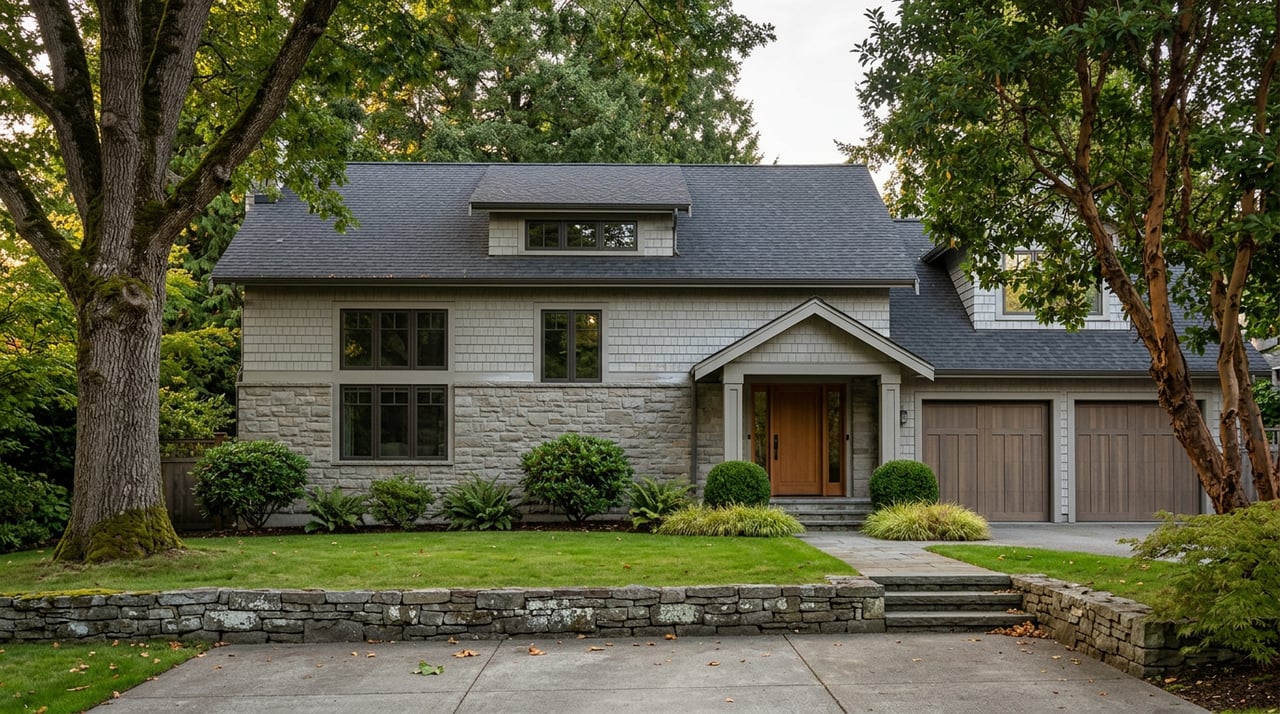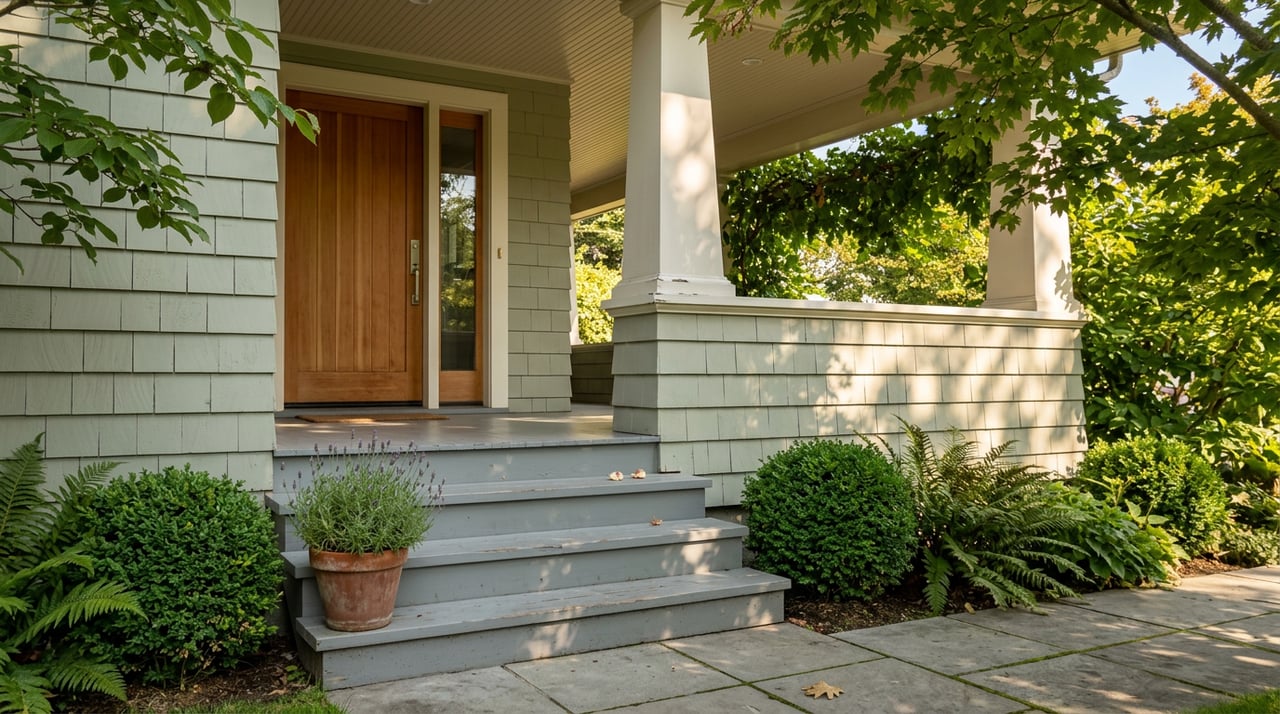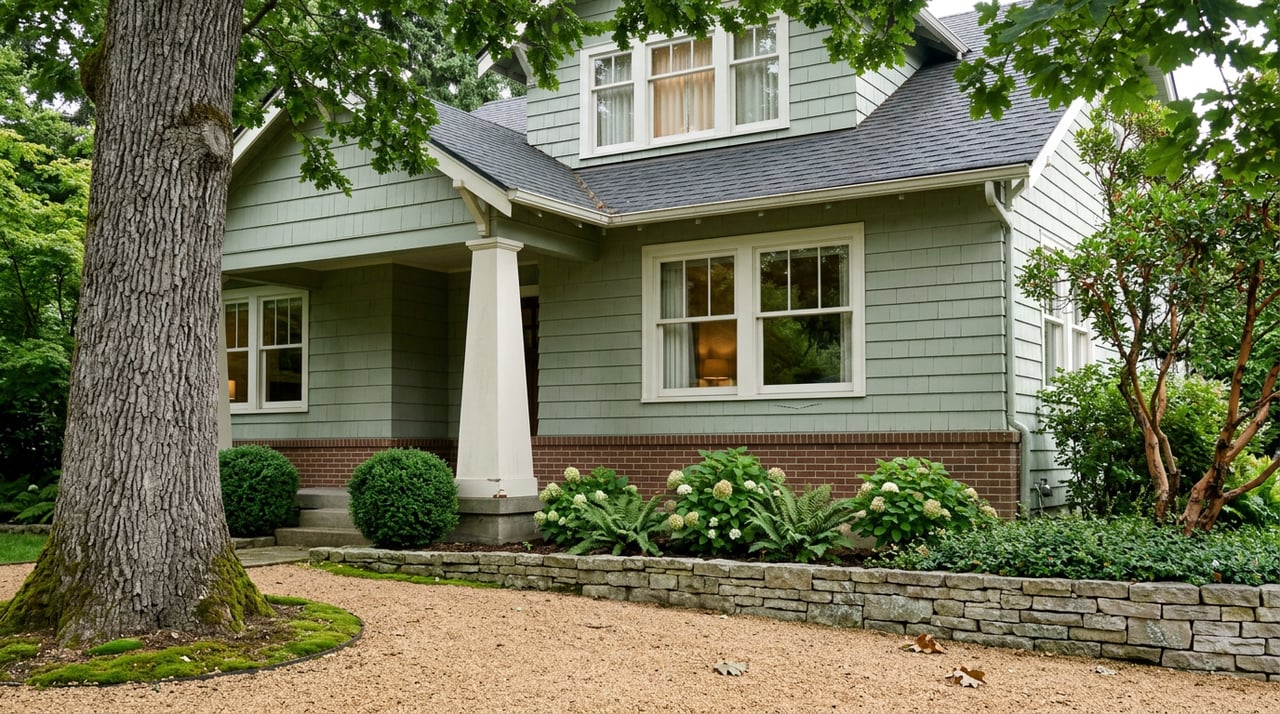
Two R2 lots on the same Oak Bay block can look identical from the curb: same frontage, same setbacks, same tidy hedge to the property line. Under the province's small-scale multi-unit housing rules, both are theoretically eligible for four dwellings. In practice, only one of them will ever get there. The difference sits in the canopy overhead, and it is measurable before an offer is written.
For buyers who have already priced Oak Bay against Fairfield or Ten Mile Point, this is the missing variable. The MLS listing tells you what the house is. Bylaw 4742 tells you what the lot can become.
The number that actually caps a redevelopment plan
Oak Bay's Tree Protection Bylaw sets canopy cover targets by zoning. On R2 lots, the target sits at 45%, and canopy cover securities are collected to enforce it. A recent staff review of a single R2 property calculated a 45% canopy cover requirement against a starting canopy of roughly 6%, requiring 540 square meters of new canopy and a minimum of five planted trees to reach the target. That is the mechanism most buyers never see quoted in a listing.
The district-wide backdrop is a canopy cover target of 40% by 2045, tied to Oak Bay's Urban Forest Strategy. What matters at the lot level is that a redevelopment application is expected to land inside the zoning-specific target on its own footprint. If the existing canopy is high, the ceiling is easier to hold. If it is low and the mature trees on adjacent public land do the visual work, the arithmetic gets harder.
What the bylaw actually protects
Protection thresholds under Bylaw 4742 are not intuitive, and this is where two similar-looking lots diverge. Protected trees include:
- Garry oak, arbutus, Pacific dogwood, and Pacific yew at a basal diameter greater than 4cm or a height greater than one metre
- Any other species at a diameter of 60cm measured at 1.4m off the ground
- Trees on slopes above 33% and trees near watercourses at any size
- Boulevard trees and trees on Oak Bay–owned land
Special care applies to arbutus, which is protected in Oak Bay particularly when pruning or planning landscaping changes. Altering a protected tree is defined as cuts larger than 10cm in diameter or removing more than 25% of total canopy volume in one year, and topping the live crown is not permitted. That definition matters when a buyer plans a "light" renovation that assumes crown reduction to open sightlines.
The species list is not decorative. Garry oaks are considered a keystone system for the region, and removing roughly 30 mature natives can create a gap that is irreplaceable within human timescales, since Garry oaks can take more than 150 to 200 years to reach full maturity. In a Council chamber, that fact reads as ecological. In a pro forma, it reads as risk.
The Lansdowne case, in plain view
The clearest recent illustration is on Lansdowne Road, in the Uplands. Two adjacent R2 lots at 2830–2850 Lansdowne were proposed for six residences under SSMUH, accessed by a shared driveway. The proposal was declined as presented, and a developer re-submission returned to the January 26, 2026 Council agenda.
The published concerns from Council were not about density in the abstract. They were about form and canopy. Council refused permission to build as presented and asked the applicant to revisit the design, further engage with Oak Bay's Planning Department, and return with a revised proposal, citing concerns about massing, proportion of dwelling space to lot, landscaping versus built square footage, and impact on the tree canopy.
The Uplands Neighbourhood Association framed the underlying test cleanly: whether the planting plan would meet the 45% tree canopy coverage target required for R2 zoned properties under the Tree Protection Bylaw. On a neighbourhood where canopy cover sits at approximately 44%, that target is a live constraint, not a rounding exercise.
For a buyer weighing an Uplands acquisition on the theory that four units are now automatic, Lansdowne is the counter-example worth reading twice.
What a buyer can read from the sidewalk
A tree survey costs money and takes weeks. A walk-around before writing an offer costs an hour. The bylaw makes the exercise unusually productive, because the trees that most constrain redevelopment are the ones a resident notices first.
- Count the protected species by eye. Garry oak, arbutus, and Pacific dogwood are visually distinctive and protected from 4cm basal diameter upward. On a mature Oak Bay lot, one specimen tree is common. Three or four is a canopy problem for anyone planning demolition.
- Estimate existing canopy honestly. If mature crowns already shade most of the buildable footprint, the 45% R2 target is close to met and the tree count leans in favour of retention. If the lot is exposed and the shade is borrowed from a neighbour's yard, the math has to be made up on-site.
- Note the driveway envelope. Wide shared driveways were the pinch point in the Lansdowne re-submission. Where a protected tree sits inside the access corridor, unit count usually gives before the tree does.
- Look for arbutus near foundations. Arbutus is notoriously intolerant of root disturbance. A protected arbutus within a demolition or excavation zone converts a tear-down thesis into a keep-and-renovate thesis.
None of this replaces an arborist. It does replace the assumption that all R2 lots are equal at the offer stage.
Where the June 2026 market meets canopy math
The Greater Victoria board's June 2026 numbers give this friction a price. A total of 719 properties sold in the Victoria Real Estate Board region in June 2026, 5.5 per cent fewer than in June 2025, with condominium sales down 26.9 per cent and single family sales down 3.5 per cent year over year. Active listings closed the month at 4,054, up 7.3 per cent from June 2025. The Chair's read on the shift is direct: the market remains active and balanced, but no longer operates in the low-inventory environment that drove intense competition and pricing pressure during the pandemic years.
For the Victoria Core benchmark home, the single family MLS HPI value in June 2026 was $1,326,500, down 0.6 per cent from June 2025 and down from May's $1,339,000. The important cell in the June report for lot buyers sits elsewhere: list-to-sale price ratios in June 2026 averaged 98 per cent for single family, 98 per cent for condos, 98 per cent for row and townhouses, 95 per cent for manufactured homes, and 90 per cent for residential lots.
That 90% ratio is the tell. Lots are the property type most exposed to future-use assumptions, and the market is discounting them accordingly. In Oak Bay specifically, a lot's future use is not set by SSMUH alone. It is set by the interaction of SSMUH with Bylaw 4742. Two lots priced at parity by algorithm can carry very different redevelopment ceilings once the trees are counted, and the softer clearance ratio gives an informed buyer room to price that gap into the offer rather than the survey.
Sellers holding a high-canopy lot
The opposite side of this trade is worth stating plainly. A high-canopy R2 lot with mature Garry oak and arbutus is not a redevelopment lot. It is a heritage-adjacent residential asset whose value is in the standing trees and the home that shelters under them. Marketing that lot as a four-unit opportunity invites the softer 90% lot pricing without the redevelopment upside a builder would need to justify it.
A cleaner strategy positions the lot to the buyer who wants exactly what is there: a single family home, retained canopy, and a designed relationship to the mature planting. That buyer pays closer to the 98% single family ratio. The trees carry the price.
A short FAQ
Does a Tree Protection Application slow a sale? Not directly. It slows what a buyer can do after closing. Any cutting or altering of a protected tree requires a permit through the Manager of Parks Services under Bylaw 4742, and permits for otherwise healthy trees are limited to specific grounds.
What if a protected tree is already dead or dying? Even protected trees that are dead or dying require a permit under comparable frameworks in this region, and Oak Bay treats dormant trees as still potentially protected. Replacement trees or cash-in-lieu can apply.
How does this interact with the province's four-unit rule? The four-unit floor sets a zoning ceiling. The canopy target sets a site ceiling. Whichever binds tighter is the one that governs the actual build.
Is the bylaw likely to loosen? The direction of travel in the region is toward more protection, not less. Saanich is currently updating its own tree bylaw, with a shift toward canopy cover based outcomes achieving 44% canopy cover by 2064 and bylaw drafting, testing and legal review continuing through Fall 2026.
Oak Bay rewards buyers who read a property before they read a listing. If you are weighing an Oak Bay lot this season and want a considered view of what it can, and cannot, become under the current bylaw and market, FarupScott Group is glad to walk it with you. Connect with us.